EN
 CN
 fr
 es
 ar
 ru
 de
 pt
 tr
 vi
 it
 ja
 ko
 hi


Why groundwater iron removal is usually easier than manganese removal
Dissolved iron is usually easier to remove from groundwater than dissolved manganese for one practical reason: at the pH most wells run, iron oxidizes on contact with air in minutes, while manganese needs either a pH above roughly 9 or a catalytic surface to oxidize at a useful rate. The gap shows up in oxidation speed, pH tolerance, contact time, and how much filter bed the solids load. A filter sized and dosed for iron alone will often pass manganese straight through. This article explains the chemistry behind that difference and what it changes when you select media, set contact time, and plan regeneration.
Iron and manganese at a glance
Both contaminants arrive as soluble divalent ions, Fe2+ and Mn2+, in reducing groundwater, and both must be oxidized to insoluble solids and then strained out. The work is the oxidation step, and there the two metals diverge sharply. The table below sets the contrast that the rest of the article explains. A separate guide walks through iron and manganese in well water for readers scoping a smaller system.
| Dimension | Iron (Fe2+) | Manganese (Mn2+) |
|---|---|---|
| Oxidation with air at neutral pH | Rapid; minutes once pH clears 6.5–7 | Negligible; needs pH above ~9 or a catalyst |
| pH that makes removal practical | 6.5–8.5, fastest near 8–9 | Above ~9 unaided; roughly 7.5+ on catalytic media |
| Contact time by aeration alone | 20–50 min | Up to 80 min |
| Filter loading and rate | Bulk Fe(OH)3 floc, runs 10–15 m/h | Smaller solid, catalytic sites saturate, runs at or below 6 m/h |
| Oxygen demand per mg removed | ~0.14 mg O2 | ~0.29 mg O2 |
What actually happens in the filter
Manganese dioxide filter media works by oxidizing soluble Fe2+ and Mn2+ to insoluble forms and holding them in the bed, so the same material can treat both metals. The catch is the oxidation step. Iron leaves solution as ferric hydroxide floc, Fe(OH)3, which is bulky and easy to trap. Manganese leaves as MnO2, a much smaller solid that only forms once the metal has actually been oxidized, which is the hard part. How manganese sand removes iron walks through that oxidation-and-strain path in more detail.
Why oxidation speed differs
Iron oxidizes on contact with dissolved oxygen as soon as the water is not strongly acidic. Treatment references put the completion time at about 10 minutes at pH 7.2 and closer to an hour at pH 6.9, so the reaction is fast and forgiving across the range most wells occupy. Manganese is far slower: homogeneous oxidation by oxygen needs a pH of about 9.5 or higher to finish within an hour, and at neutral pH it is effectively stalled.
Part of the reason is stoichiometric. Iron moves one electron from Fe(II) to Fe(III); manganese must move two, from Mn(II) to Mn(IV), so it sits higher on the redox scale and resists oxidation. A second, practical complication appears when both metals are present: ferrous iron acts as a reducing agent that slows manganese oxidation, so in mixed water the iron has to be dealt with first. You cannot treat manganese and iron as equal loads and expect both to clear in the same pass.
Why pH is the second divider
Iron is effectively removed from about pH 6.5 to 8.5 and oxidizes fastest near pH 8–9. Manganese is the opposite: unaided it needs the water above roughly 9, which is a level most groundwater never reaches, and even catalytic media stop working well below about pH 7.5. For this media, removal and regeneration both falter once the water drops below about pH 7.5. The backwashing and regeneration requirements cover that pH dependence together with the oxidant feeds that keep the catalytic surface active.
This single point is why iron projects feel easier. Iron often needs no chemical adjustment at all, while manganese frequently needs lime or caustic to lift pH, or a strong oxidant such as chlorine or permanganate, before the bed will do its job.
Contact time and filter load
Without catalytic media, plain aeration followed by filtration needs long detention: roughly 20–50 minutes for iron and up to 80 minutes for manganese at neutral pH, which means contact tanks and floor space. Catalytic manganese dioxide media collapse that to 15–30 seconds of contact and allow high filtration rates of 6–12 gallons per minute per square foot. Greensand sits in between but runs slowly, around 3 gpm/ft2, and depends on a continuous or intermittent permanganate feed.
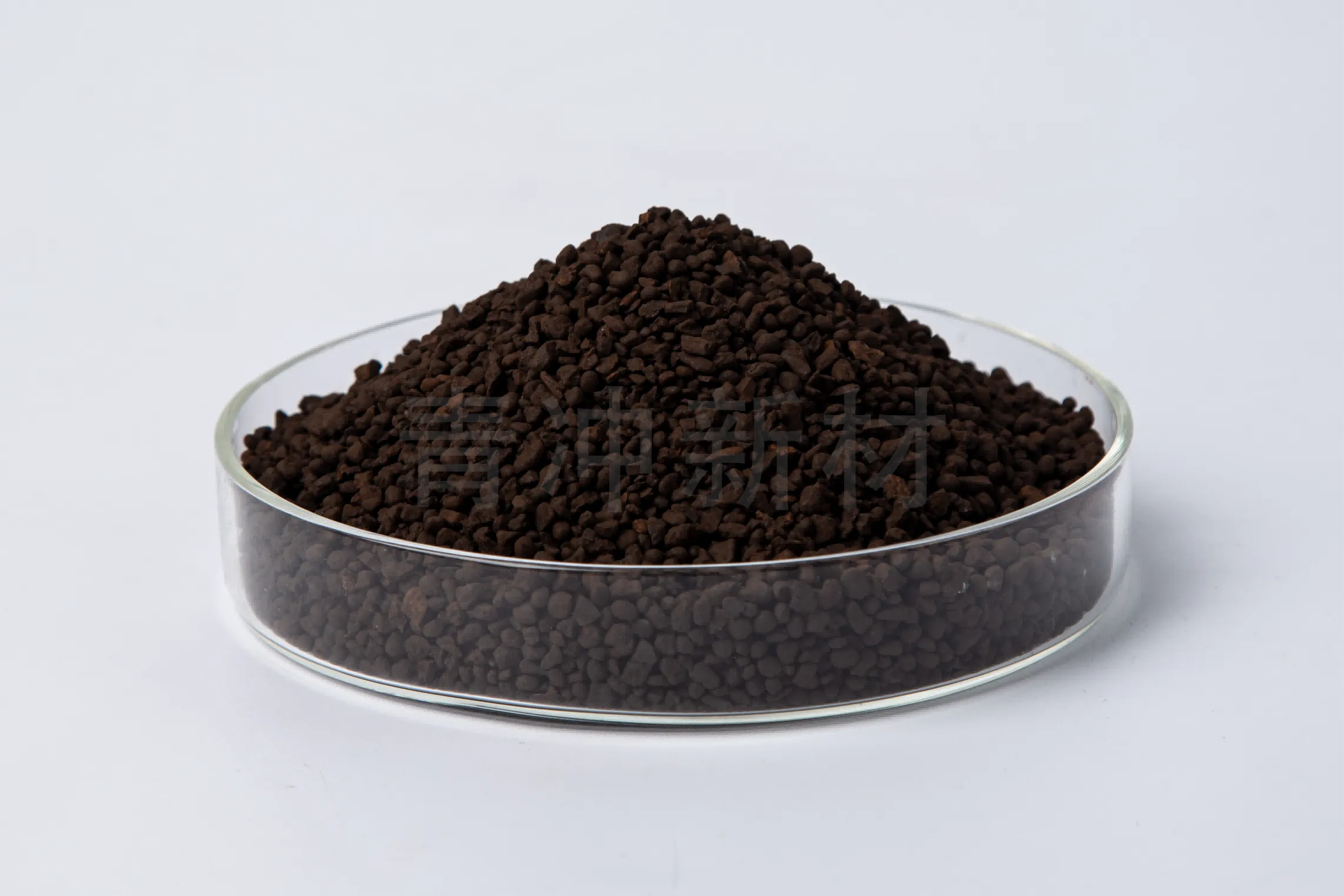
Field practice puts the filter-rate contrast plainly: iron filtration is run at 10–15 m/h, while manganese removal is held at or below 6 m/h. So manganese not only demands more contact time, it also needs a larger vessel or a lower throughput for the same flow. The bed load differs in kind as well. Iron deposits a bulky Fe(OH)3 floc that clogs the upper layer and shortens runs, while manganese loads and eventually exhausts the catalytic surface, which is why it needs regeneration rather than just backwashing. The manganese filter media product page lists the MnO2 content, density near 2.5–2.6 g/cm3, and particle cuts that set the bed’s contact performance and backwash tolerance.
How to specify the right media
Do not size a manganese system the way you would size an iron one. Start from a water analysis that reports dissolved and total iron, manganese, pH, dissolved oxygen, and alkalinity, then work through the checks in order.
- If only iron is present and pH is above 7, simple aeration plus filtration is often enough, and catalytic media is a compact alternative.
- If manganese is present, plan to raise pH toward 8–9 or to use catalytic MnO2 media, and budget for regeneration with chlorine or permanganate.
- Expect a lower filter velocity and a larger vessel for manganese than for an equivalent iron load.
- When both metals are in the water, remove the iron first; its presence suppresses manganese oxidation.
- Choose the particle cut and backwash regime from the analysis, not from a generic sieve window.
A catalytic manganese dioxide filter media of natural ore, MnO2 content from 35 to 90 percent, treats both contaminants by contact oxidation. The right cut, bed depth, and regeneration dose depend on the water in front of it, so the analysis, not the price per tonne, should drive the specification. The water treatment application overview shows where this media fits among the manganese compounds used in purification.
Next step
Send your water profile for a media recommendation
Send the iron, manganese, pH, dissolved oxygen, alkalinity, design flow, vessel diameter, bed depth, and coldest washwater temperature. We return a particle cut, a regeneration regime, and a sample matched to your water.
FAQs
Can an iron filter remove manganese?
Usually not on its own. Plain aeration and sand filtration oxidize iron readily at neutral pH but leave dissolved manganese almost untouched, because manganese needs a much higher pH or a catalytic surface to oxidize. A filter built on catalytic manganese dioxide media, with adequate pH and regeneration, can handle both; an iron-only system generally cannot.
Why does pH matter so much for manganese?
Manganese oxidation by oxygen is strongly pH dependent. Below about pH 7.5 even catalytic media lose effectiveness, and unaided oxidation only becomes practical above roughly pH 9. Iron, by contrast, oxidizes well from pH 6.5 upward, so manganese is the contaminant that usually forces a pH adjustment or a strong oxidant.
Does manganese removal need more contact time?
Yes. By aeration alone manganese can need up to 80 minutes of contact at neutral pH and is filtered at roughly half the rate, around 6 m/h or less versus 10–15 m/h for iron. Catalytic manganese dioxide media cut contact time to seconds and raise the rate, which is why they are the standard answer when manganese is present.