EN
 CN
 fr
 es
 ar
 ru
 de
 pt
 tr
 vi
 it
 ja
 ko
 hi


Manganese sand particle size: what changes when you go coarser or finer
The particle size specification should be selected based on the specific requirements of the filter bed, rather than focusing solely on the price per ton. A 0.5–1.0 mm manganese sand holds iron and manganese near the surface, gives clearer filtrate and needs less water to lift it, but fills fast: head loss climbs, runs shorten, backwashing gets more frequent. A 1.0–2.0 mm cut drives solids deeper, stores more between washes and takes a higher rate, at the cost of passing finer floc and needing a stronger wash. Moving from one cut to the other roughly doubles grain diameter, which quadruples clean-bed resistance.
A quotation naming only the assay and price per tonne leaves all five open: solids held per run, head loss added, rate tolerated, whether your pump can clean it, and whether the media survives two years.
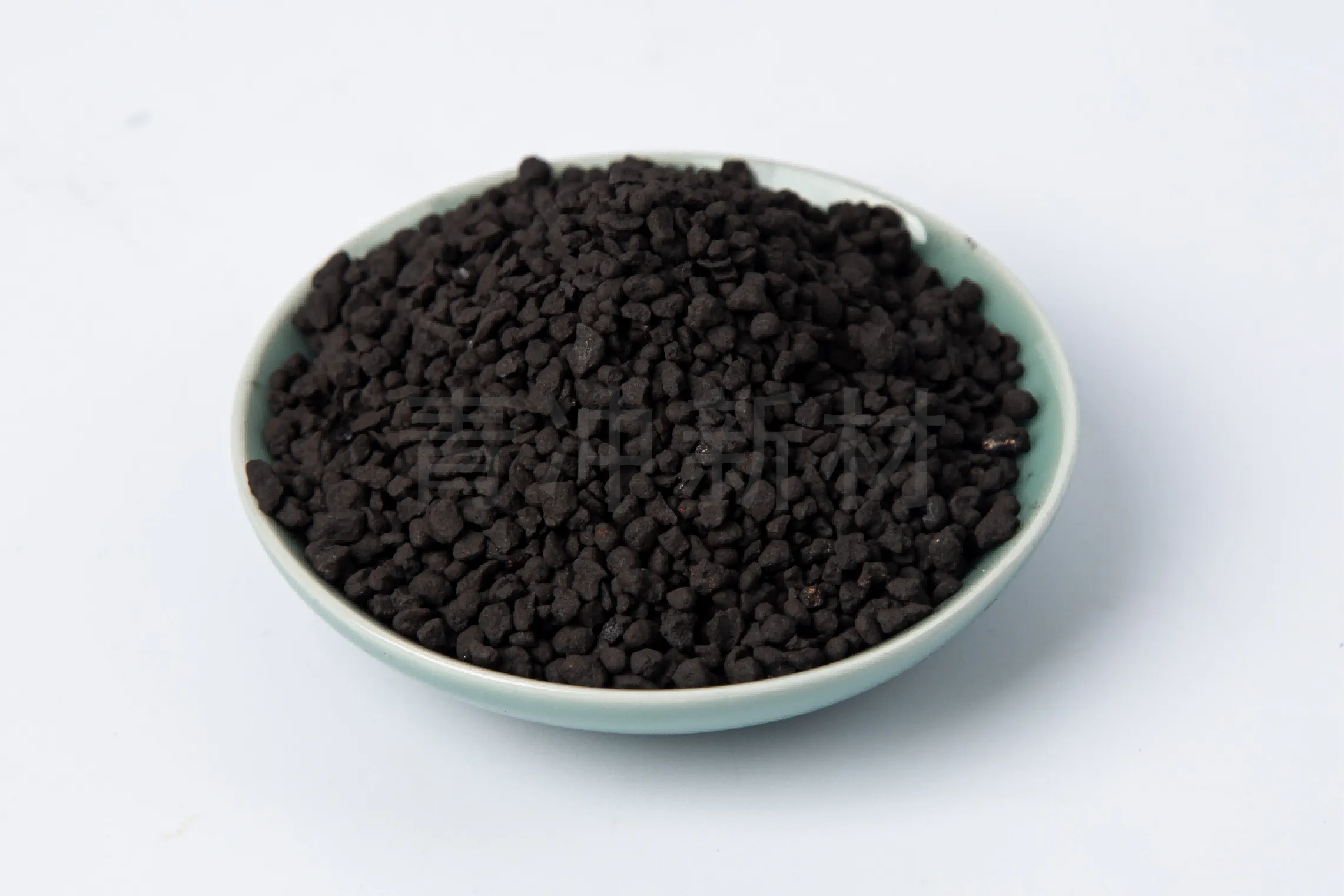
What a size label leaves out
A cut such as 0.5–1.0 mm is a sieve window: grains pass a 1.0 mm sieve and are retained on a 0.5 mm one, and two suppliers can fill it with different material. Specifications use two numbers instead. Effective size, d10, is the diameter at which 10 percent by weight is finer, and describes the fine end that does most of the filtering and most of the flow resistance. The uniformity coefficient, UC, is d60 over d10, and describes the spread: a narrow one fluidises evenly and re-stratifies predictably after each wash, a wide one blinds at the top and leaves coarse grains the wash cannot move.
Capture capacity: where the iron actually stops
Removal happens twice: dissolved iron and manganese oxidise on the MnO2 surface, and the particles are strained out in the voids. Halve the grain diameter and specific surface per cubic metre roughly doubles, which is why the fine cut polishes better. Floc is caught in the upper layer rather than through the depth, so filtrate stays clearer and a tight limit is easier to hold.
The cost is capacity. Capture in a thin top layer leaves most of the bed unused, terminal head loss arrives with clean media still underneath, and the run ends early. The coarse cut spreads the same solids deeper and holds more per run, though each cubic metre of it captures less.
Head loss: the cost of halving the grain
Clean-bed head loss follows the Carman-Kozeny relation: proportional to flow rate, inversely proportional to the square of grain diameter. Halve the diameter and resistance per metre roughly quadruples at the same rate, before a milligram of iron has been captured. The gap between the two standard cuts approaches that factor of four.
That decides whether a filter fits its pump. Where vessel, pump curve and terminal pressure were set for 1.0–2.0 mm, moving to 0.5–1.0 mm lifts the clean-bed baseline and can leave a bed tripping on differential pressure hours after a wash. Less depth or a lower rate compensates, each at a cost. The capture side is in how manganese sand removes iron.
Filtration rate belongs to the bed, not the pump
Rate is flow divided by plan area, so an existing vessel fixes it before media is discussed. A 1.0–2.0 mm bed runs faster because its voids are larger and its loss lower, which is why a plant short of area picks it. A 0.5–1.0 mm bed run at that rate blinds at the surface and shortens the cycle. Fix the rate first, then take the finest cut it can carry.
Backwash intensity: what your pump can deliver
A bed only cleans when it fluidises, and the rate needed rises steeply with grain diameter and density. A 0.5–1.0 mm bed lifts at a rate that leaves a 1.0–2.0 mm bed sitting on the support layer while water channels through. If the pump was sized for finer media, the coarser cut is the wrong purchase however well it filters in week one.
Guidance for this media puts working expansion at 30 to 40 percent, enough for grains to collide and shed their oxide coating. The rate producing it is not constant: cold water is more viscous and lifts a bed further at the same flow, so a wash set in summer can over-expand in winter and carry grains to drain. Check both ends of the year against freeboard and trough height. Backwashing and regeneration requirements cover the sequence and air scour on heavy iron loads.
Carryover: where the fines go
Media leaves when upward velocity in a wash exceeds the settling velocity of the grain. Fines settle slowly, so they go first, at rates that barely disturb the coarse fraction. A wide grading is therefore a liability out of proportion to its average size: the fine tail of a load sold as 0.5–1.0 mm can be gone within a season while the bed looks intact. There is no visible failure, only top-ups and runs that keep shortening. Sieve a washwater sample and compare d10 with the delivered curve; a rising d10 means the fines are leaving.
Run the checks in this order
Check the duty from the water analysis and effluent limit, then the rate from flow and plan area, then the head available against the loss each cut adds, then whether the wash fluidises that cut at the coldest water. If the head or wash check fails for both cuts, grain size is not the answer: the fix is a graded bed, a lower rate or another vessel.
| What it decides | 0.5–1.0 mm cut | 1.0–2.0 mm cut |
|---|---|---|
| Solids capture | Higher per unit depth; floc held near the surface | Loads deeper; more solids per run |
| Clean-bed head loss | High; up to four times the coarser cut | Low; the main reason runs are longer |
| Rate tolerated | Lower ceiling; surface blinding sets it | Higher ceiling; depth has room to work |
| Wash rate to fluidise | Lower; suits a modest backwash pump | Higher; a fine-sand pump may not clean it |
| Carryover risk | Higher per unit of wash rate; fines leave first | Lower, though a wide grading loses its tail |
Put the specification on the inquiry, not the price
Price per tonne compares only when specifications match, and manganese sand is quoted across cuts, assays and gradings as though these were one product. Two loads at the same price can differ fourfold in head loss, and the wider grading loses its fines sooner.
QingChong makes manganese filter media from natural ore in 0.5–1.0 mm and 1.0–2.0 mm cuts, other gradings to order, at MnO2 35 to 90 percent, iron capped at 8 percent and silica at 15 percent. That option matters where the cut has to follow vessel and wash rate: a supplier able to make the grading can meet a d10 target instead of the nearest stocked window. See the manganese filter media range and the water treatment application notes.
Next step
Size the bed on your water, not the quotation
Send the water analysis, flow, vessel diameter, bed depth, effluent limit, backwash rate and coldest washwater temperature. We reply with a cut recommendation, its sieve curve and a sample.
FAQs
Is the finer cut always safer when the iron limit is tight?
No. It is safer only where rate and wash support it. Above that rate a 0.5–1.0 mm bed blinds at the surface and you wash more often for no gain in clarity.
Can I blend the two cuts to get both benefits?
Blending on site does not make a graded bed. The cuts stratify during the first backwash, fines rising into a dense top layer that blinds early. A dual-layer works only when each layer is sized against the other.
Will a coarser cut fix short filter runs?
Only if head loss ends the run and the wash can fluidise the coarser bed. If runs end on manganese breakthrough, coarser media makes it worse: less surface, less contact.
What documentation should arrive with each lot?
A certificate of analysis with d10, d60 and UC from a sieve analysis, plus assay, iron, silica, moisture and attrition with its method. Keep the curve so the in-service grading can be compared later.