EN
EN
 CN
CN
 fr
fr es
es ar
ar ru
ru de
de pt
pt tr
tr vi
vi it
it ja
ja ko
ko hi
hi

EMD for AA and AAA Carbon-Zinc Batteries: What to Confirm Before You Order
AA and AAA are sizes, not specifications. Before you ask for a price on electrolytic manganese dioxide (EMD) for carbon-zinc cells, fix four inputs: the IEC designation you build (R6S, R6P or R03), the electrolyte and cathode recipe behind it, the discharge test and pass threshold you accept, and the manganese material you run today. Those inputs decide whether EMD is the right route, what cathode share it should carry, and which impurity, particle and moisture limits belong in the contract. Send them with the inquiry and you get a quotation you can evaluate. Send only "EMD for AA carbon zinc" and you get a price that says nothing about fit.
Start with the IEC designation, not the shelf size
Carbon-zinc AA and AAA cells are R6 and R03 under IEC 60086. The letter after the number changes the obligation: S for standard, C for high capacity, P for high power. IEC 60086-2 sets separate minimum average durations (MAD) for R6P and R6S.
The gap is material. In the R03 tables, zinc-carbon carries a MAD of about 50 minutes for portable lighting (5.1 ohm, 4 minutes on and 56 minutes off, 8 hours per day, 0.9 V end voltage), against 130 minutes for alkaline LR03. Delayed discharge after 12 months is set at 80% of MAD for zinc-carbon and 90% for alkaline. Confirm the edition you sell against.
An R6P built for motorised toys loads the cathode differently from an R6S built for clocks. The 80% retention target also puts shelf behaviour on the material, because self-discharge and moisture both consume it.
Name the electrolyte and the cathode recipe
Carbon-zinc covers more than one chemistry. The classic Leclanche cell uses ammonium chloride; heavy-duty and high-power variants use zinc chloride. The cathode holds manganese dioxide, acetylene black and a large liquid fraction. Since the zinc can is both anode and container, these cells are usually cathode limited, so the manganese dioxide you buy sets much of the service life.
The EMD share matters more than the EMD label. State whether EMD is the only manganese source or is blended with natural or chemical manganese dioxide and at what ratio, because blending moves cost per cell, discharge time and storage behaviour together. QingChong's dosage reference puts MnO2 at about 30-40% of zinc-carbon cell weight, roughly 5-7 g in an AA.
Choose between EMD and discharge manganese powder on the cell target
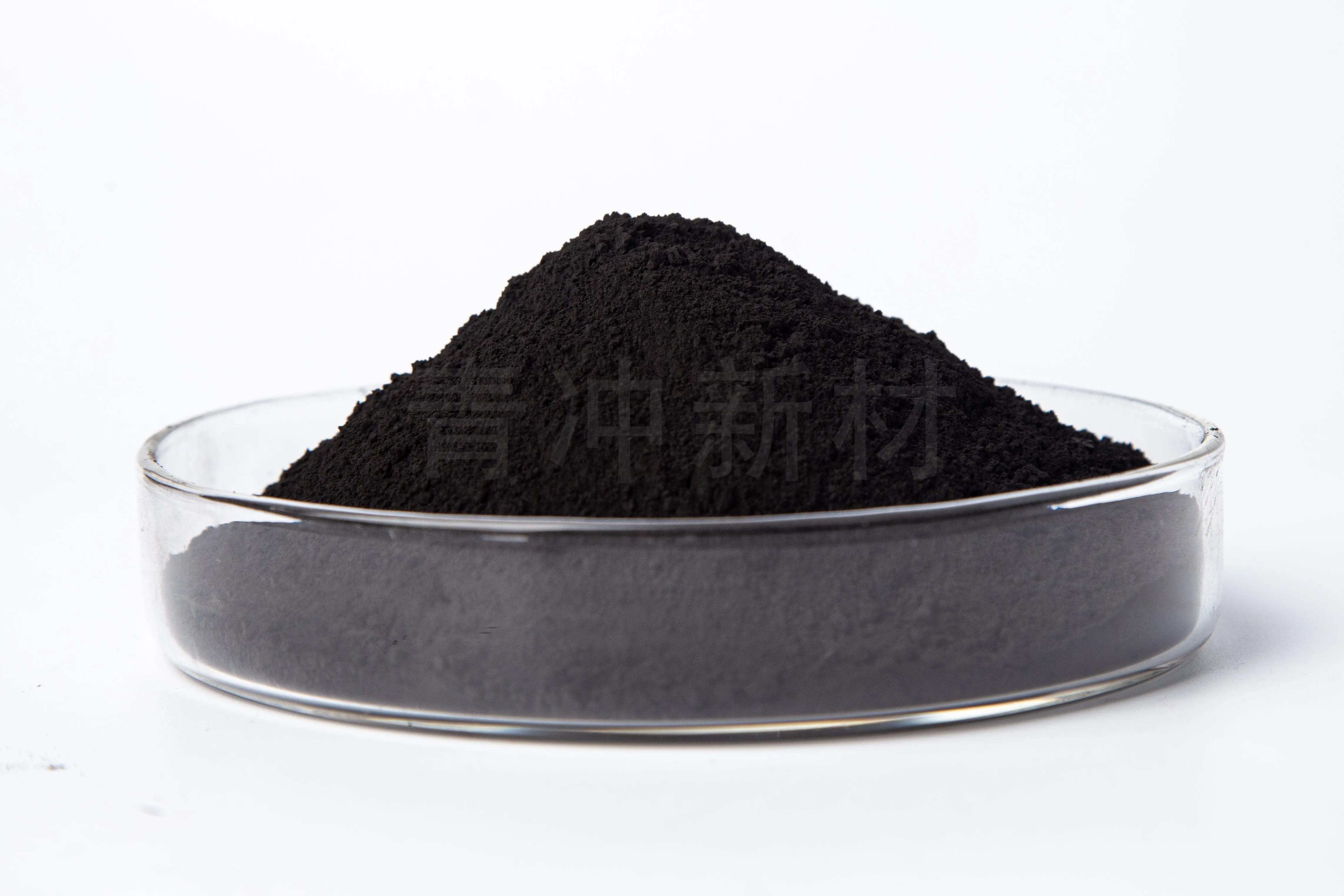
The two QingChong routes for zinc-carbon cathodes differ in more than assay. EMD is specified at 90% MnO2 minimum, iron 200 ppm maximum, moisture 3% maximum, pH 5-7.5 and 200-325 mesh, made by electrolysis from manganese sulfate. Discharge manganese powder is specified at 60% MnO2 minimum, iron to 6%, silica to 15%, pH 5-7.5 and 120-325 mesh, supplied against a discharge time over 300 minutes. Taken directly from pyrolusite, its production cost is significantly lower.
The trade-off is cost per tonne against cost per accepted cell. For a price-driven R6S with a short shelf claim, the lower-cost route can be the right engineering decision. For R6P grades, export retail or a three-year shelf claim, tighter impurities and higher activity reduce the risk of missing MAD, missing retention, or leaking in the field, which usually costs more than the material saving.
Fix the discharge method before comparing numbers
A discharge time is a result under one configuration. Even the 300-minute figure means nothing until the circuit is fixed: load, duty cycle, temperature, end voltage, conditioning, cathode mass and sample size. The same applies to any activity figure quoted for EMD.
Anchor the comparison. If the cell is sold as IEC compliant, name the IEC 60086-2 application test you must pass. If a customer specification governs, attach it in full, require supplier data on the same protocol, and treat internal data as screening only. At 80% of MAD for zinc-carbon, a fresh-cell result alone cannot support a shelf-life claim.
Convert particle size, moisture and pH into process inputs
Mesh ranges are screening bands, not distributions. Ask for D10, D50 and D90 with the method, plus bulk and tap density, fines and dust behaviour. Distribution drives paste viscosity, mixing torque and cathode density, and a density shift changes the mass a volumetric feeder delivers per stroke even when the assay holds.
Moisture is quoted at 3% maximum on both routes. Confirm the basis, as received or loss on drying at a stated temperature, and the packaging: liner, bag construction and storage humidity. Powder inside the window at the factory can arrive outside it after a humid sea route. pH sits in the same 5-7.5 band on both products, but ammonium chloride and zinc chloride systems do not buffer alike.
Set impurity limits from your failure history
Impurity limits are not paperwork here. Technical literature on zinc-carbon cells notes that iron, cobalt, antimony and other metals with low hydrogen overpotential accelerate localised corrosion of the zinc can, causing perforation and leakage. Where the can is the anode, leakage is a recall risk rather than a scrap statistic.
Request a panel with units and detection limits: Fe, Cu, Ni, Co and Pb, plus soluble chloride, sulfate and alkali where your formulation is sensitive. EMD at 200 ppm iron and discharge manganese powder at 6% iron with 15% silica are different propositions, not two prices for one material. Set limits from your own scrap data, and add RoHS, REACH and mercury or cadmium declarations to the order.
The confirmation package to send with the inquiry
State the following and quotations become comparable.
| Confirm | What to state | If it is missing |
|---|---|---|
| Cell and standard | R6S, R6P or R03, and the IEC or national edition you must pass | Generic grade, no performance link |
| Electrolyte and recipe | Ammonium or zinc chloride, EMD share, blend partners, carbon and binder levels | Limits cannot match the cell |
| Particle and density | D10/D50/D90 with method, bulk and tap density, feeder type | Viscosity and dosing drift |
| Impurities and compliance | Fe, Cu, Ni, Co, Pb and soluble species, plus RoHS or REACH declarations | Shelf life and access assumed |
| Discharge acceptance | Load, duty cycle, end voltage, sample size, fresh and 12-month thresholds | Discharge data not comparable |
Add monthly tonnage and packing format to the same message.
What to request before the first bulk order
QingChong publishes TDS, SDS and COA downloads on its EMD product page and covers MOQ, delivery time, packaging, samples and customisation also in its basic information part. You can review the information before sending the first inquiry. Agree the incoming inspection plan, including release tests, retain period and the out-of-specification action, before the first container.
For samples, request enough material for a laboratory cell build under your production recipe plus a retained reference from the same lot, then run discharge, storage and leakage checks against today's material on one protocol.
Send the package through the QingChong inquiry route: cell designation, electrolyte system, cathode recipe with EMD share, the discharge test and threshold you must meet, and the last COAs of your current manganese material.
FAQ
Does one EMD grade suit both R6P and R6S carbon-zinc cells?
Not automatically. R6P is defined as high power and R6S as standard, with different discharge duties and MAD values, so one powder can pass a clock test and fail a motorised-toy test. State the designation and target test with the inquiry.
Is higher MnO2 content always better for AA and AAA zinc-carbon cells?
Assay is a screen, not an acceptance criterion. QingChong specifies EMD at 90% MnO2 minimum with iron at 200 ppm maximum, and discharge manganese powder at 50% MnO2 with iron to 6%. Choose by discharge duty, shelf-life claim and leakage risk, then confirm on your line.
Which particle data should the inquiry specify?
Specify D10, D50 and D90 with the measurement method, plus bulk and tap density and the fines fraction. A mesh band alone, 200-325 mesh for EMD or 120-325 mesh for discharge manganese powder, does not show whether the powder will mix, pack and feed as your line needs.
Can I get documents and a sample before a bulk order?
Yes. QingChong provides TDS, SDS and COA downloads for electrolytic manganese dioxide, and the basic product information also covers MOQ, delivery time, packaging, samples and customisation. Confirm order-specific values in writing and request enough sample for a laboratory cell build.