EN
EN
 CN
CN
 fr
fr es
es ar
ar ru
ru de
de pt
pt tr
tr vi
vi it
it ja
ja ko
ko hi
hi

Manganese Dioxide in Water Treatment Applications
Manganese dioxide (MnO₂) plays a crucial role in water treatment due to its unique chemical properties, primarily its strong oxidizing ability and adsorption capacity. Here’s a detailed explanation of how it is used in water treatment processes:
1. Oxidation of Contaminants
Manganese dioxide is an effective oxidant that can convert soluble, problematic substances into insoluble compounds, making them easier to remove.
• Oxidation of Manganese and Iron:
◦ In groundwater, manganese (Mn²⁺) and iron (Fe²⁺) often exist in soluble forms, causing discoloration (yellow/brown water) and unpleasant tastes. MnO₂ oxidizes these ions:
◦ Manganese: Mn²⁺ + MnO₂ + 2H₂O → 2MnO₂·H₂O (insoluble manganese dioxide hydrate)
◦ Iron: Fe²⁺ + MnO₂ + 4H⁺ → Fe³⁺ + Mn²⁺ + 2H₂O (Fe³⁺ then forms insoluble Fe(OH)₃)
◦ The insoluble compounds can be filtered out, improving water clarity and taste.
• Oxidation of Arsenic:
◦ Arsenic (As³⁺) is a toxic contaminant. MnO₂ oxidizes As³⁺ to As⁵⁺, which forms insoluble arsenates that can be removed by adsorption or filtration.
• Oxidation of Hydrogen Sulfide (H₂S):
◦ H₂S causes a “rotten egg” odor. MnO₂ reacts with H₂S to form elemental sulfur (S) and water, eliminating the odor.
2. Adsorption of Heavy Metals and Pollutants
MnO₂ has a large surface area and negative charge, allowing it to adsorb heavy metals and organic contaminants:
• Heavy Metals:
◦ It adsorbs metals like lead (Pb²⁺), cadmium (Cd²⁺), and mercury (Hg²⁺) through electrostatic attraction and chemical bonding.
• Organic Compounds:
◦ Some organic pollutants (e.g., certain pesticides, dyes) can be adsorbed onto MnO₂’s surface, reducing their concentration in water.
3. Applications in Water Treatment Systems
(1) Filtration Media
• MnO₂-Coated Filters:
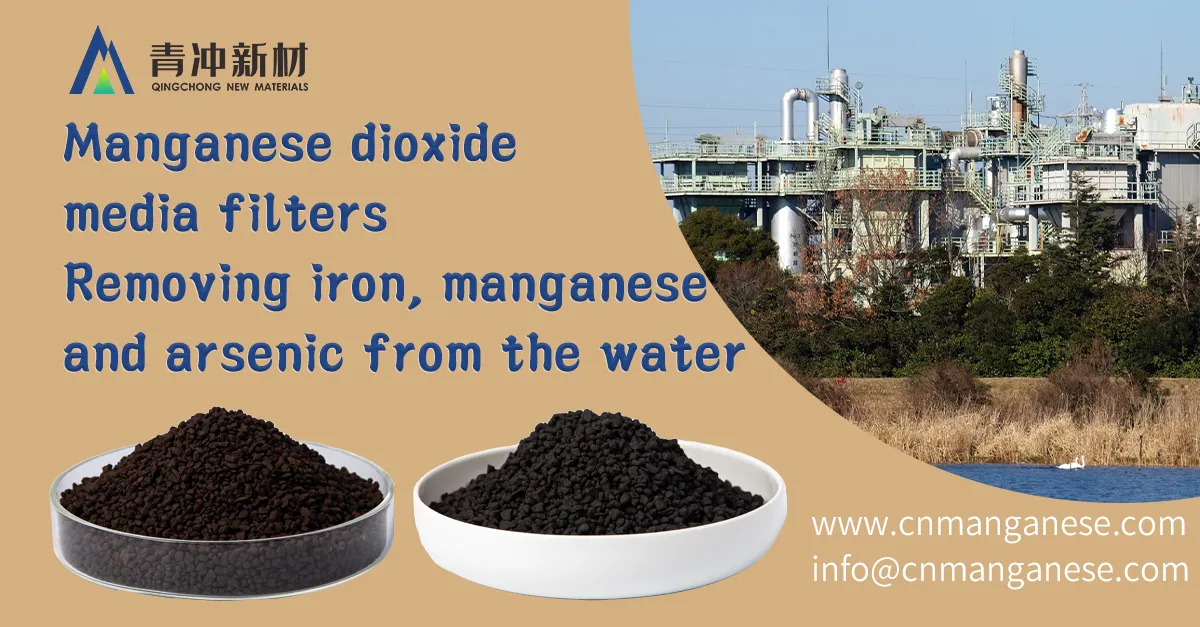
◦ Filter media (e.g., sand, activated carbon) coated with MnO₂ are used in water treatment plants. As water passes through, MnO₂ oxidizes and adsorbs contaminants.
◦ Example: Green sand filters contain MnO₂-coated silica sand, effective for removing iron and manganese.
• Natural Manganese Ore:
◦ Minerals like pyrolusite (natural MnO₂ ore) are used as filter media, especially in small-scale or rural water systems.
(2) Catalytic Role in Advanced Oxidation Processes (AOPs)
• MnO₂ can catalyze the production of hydroxyl radicals (·OH) in AOPs, which degrade persistent organic pollutants (e.g., pharmaceuticals, industrial chemicals). For example, when combined with hydrogen peroxide (H₂O₂), it enhances the oxidation of tough contaminants.
(3) Pre-Treatment in Drinking Water Plants
• In municipal water treatment, MnO₂ may be added during pre-treatment to oxidize iron, manganese, or arsenic before sedimentation and filtration, improving the efficiency of subsequent steps.
4. Advantages of MnO₂ in Water Treatment
• Cost-Effective: Natural MnO₂ ores are abundant and inexpensive, making them suitable for low-cost water treatment systems.
• Environmentally Friendly: Unlike some chemical oxidants (e.g., chlorine), MnO₂ does not produce harmful by-products.
• Long-Lasting Activity: MnO₂-coated filters can maintain their oxidizing and adsorbing capacity for extended periods, requiring minimal maintenance.
5. Limitations and Considerations
• pH Dependence: The efficiency of MnO₂ varies with pH. Optimal oxidation of iron/manganese occurs at pH 6.5–8.5, while higher pH (8–9) is better for arsenic removal.
• Regeneration Needs: Over time, MnO₂ filters may become saturated with contaminants and require regeneration (e.g., by backwashing with a strong oxidant like potassium permanganate).
• Compatibility: MnO₂ may react with certain chemicals (e.g., high-concentration chlorides), reducing its effectiveness. Water quality testing is essential before implementation.
6. Example: MnO₂ in Well Water Treatment
• Problem: Well water often contains high iron and manganese.
• Solution: A MnO₂-based filter system is installed. As water flows through, MnO₂ oxidizes Fe²⁺ and Mn²⁺ to insoluble oxides, which are trapped in the filter. Periodic backwashing with a mild acid or oxidant regenerates the filter media.
Conclusion
Manganese dioxide is a versatile material in water treatment, leveraging its oxidizing and adsorptive properties to remove metals, odors, and pollutants. Its use in filtration media, catalytic processes, and pre-treatment makes it valuable for both municipal and decentralized water systems, contributing to safer and cleaner drinking water.